When Activity Becomes a Substitute for Leadership
A distribution company begins each morning with a backlog meeting. Supervisors report delayed orders, missing inventory, driver shortages, customer complaints, and the exceptions that need approval before the day can proceed.
The operations director knows the system well. He reallocates vehicles, changes priorities, authorizes overtime, and calls the warehouse when an important order needs special handling. By the end of the meeting, the urgent problems have owners and the delayed work has begun moving again.
His performance is easy to see. Orders leave the warehouse. Customers receive explanations. Employees get decisions they could not make on their own.
Six months later, the same meeting has grown from thirty minutes to ninety. More supervisors attend. The list of exceptions is longer. Employees arrive prepared to explain the latest failure and obtain another decision from the director.
The company has become proficient at recovery. It has made little progress in preventing the failures that require recovery.
Reactive leadership often develops this way. It does not announce itself through obvious incompetence. It appears in rapid decisions, visible involvement, and a steady stream of resolved problems. The leader receives credit because the immediate results are real.
Those results can conceal a more serious weakness: the organization still depends on intervention to perform routine work.
The Appeal of Visible Action
Most organizations can measure activity more easily than improvement.
They can count meetings held, messages answered, decisions made, projects reviewed, and problems closed. These measures give leaders evidence that work is taking place. They say much less about whether the work has changed the conditions producing the problems.
A customer complaint gets resolved, but no one corrects the handoff that caused it. A manager fills an open shift, but the scheduling practice behind the shortage remains intact. A senior executive settles a dispute between departments, yet both departments retain incentives that will produce the next dispute.
Each response has value. Customers need answers, shifts need coverage, and unresolved conflict can stop useful work.
The error lies in treating recovery as progress.
Recovery restores operations after a failure. Progress reduces the chance, frequency, or cost of that failure. Leaders who confuse the two can spend years managing the same category of disruption while believing their speed proves that the organization has improved.
The distinction becomes uncomfortable when the leader excels at intervention. A capable leader may resolve problems faster than anyone else. That ability makes continued involvement appear efficient. Passing authority to a manager who has less experience may slow the decision and introduce risk.
The short-term calculation favors intervention. The director can solve the problem in five minutes, so why spend an hour helping someone else learn to solve it?
Because the five-minute solution does not remain five minutes. It returns across dozens of decisions, draws senior attention into routine work, and teaches everyone where responsibility ends. The organization saves time on each incident while building a permanent demand on the leader.
Crisis Tempo Distorts the Standard of Performance
During a real crisis, leaders must narrow their focus. They protect people, stabilize operations, contain damage, and restore essential functions. They may centralize authority because delay carries a high cost and ordinary procedures cannot meet the situation.
That operating style becomes destructive when it survives the crisis.
A leader working at crisis tempo tends to reward immediate responsiveness. Employees learn to elevate anything that may become urgent. Managers compete for access. Teams adopt temporary workarounds because permanent correction would take longer. Decisions move toward the center because senior approval feels safer than local judgment.
The organization then produces the evidence that seems to justify continued crisis leadership. More issues reach the leader, more exceptions require attention, and more employees hesitate to act without approval.
A feedback loop takes hold:
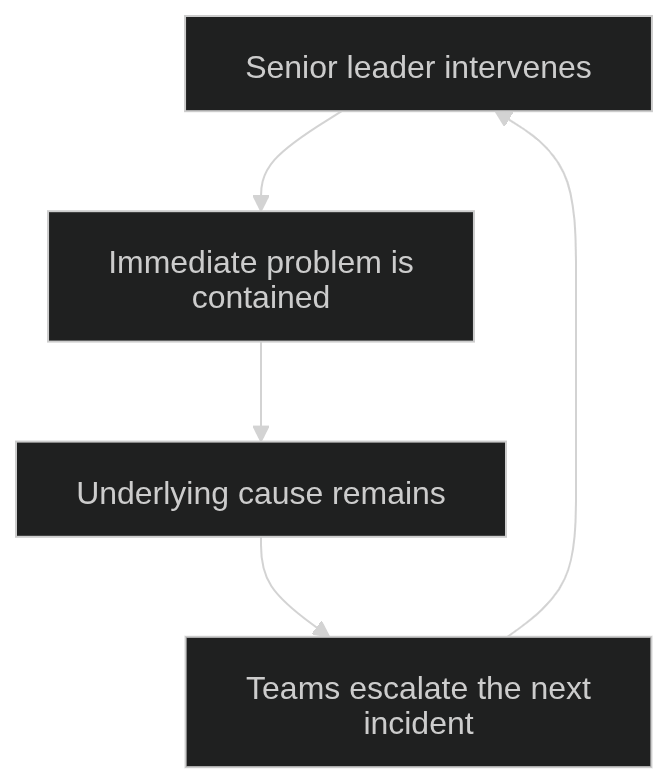
The leader sees a demanding environment. The staff sees a leader who wants involvement. Both may be describing the same pattern from different positions.
Busyness acquires moral weight in this environment. The busiest person appears the most committed. A crowded calendar signals importance. Quick replies signal command. Time spent examining an old problem can look less valuable than time spent closing a new one.
Yet the examination of an old problem may be the only work that prevents ten future incidents.
Strategic leadership requires attention to effects that do not create an immediate display of competence. A clarified decision right, a corrected incentive, or a redesigned handoff may produce no dramatic result on the day it takes effect. Its value appears later, in meetings that no longer need to occur and failures that do not reach senior leadership.
Organizations seldom celebrate avoided crises because no visible event marks the achievement. They should still measure it.
Recurrence Provides Better Evidence Than Motion
A leader who wants to distinguish activity from progress needs to track recurrence.
After resolving a significant operational problem, record the category of failure, the immediate cause, the corrective action, and the conditions that allowed it to occur. Then examine the record over time.
The purpose is not to create an elaborate reporting requirement. A simple review can reveal whether the organization keeps paying for the same weakness under different names.
Suppose a department reports five missed deadlines over three months. Each incident has a different project, client, and employee attached to it. Management might treat them as separate performance failures.
A closer review may show that every deadline depended on approval from the same executive, that teams received the necessary information late, or that sales staff committed to delivery dates without consulting operations. The names change while the mechanism remains stable.
Leaders should examine recurring problems through four practical lenses:
Frequency: Is this category of failure becoming less common?
Dependence: Does resolution still require the same senior person?
Duration: Does the organization recover faster because the cause was reduced, or because employees have grown better at improvisation?
Transfer: Can managers handle the issue within clear authority, or does it continue moving upward?
These measures expose false improvement. A team may cut recovery time from four hours to one while the failure occurs twice as often. The faster response looks impressive, but the organization remains trapped in the pattern.
The aim is not to eliminate every disruption. Markets change, equipment breaks, employees make mistakes, and competitors create new problems. A healthy organization still encounters friction.
The test concerns repeated, preventable friction. If the same category of crisis keeps returning, leaders should assume that their previous response contained the event without correcting enough of its cause.
The Leader Must Preserve Enough Distance to Think
Reactive environments consume attention in small increments. A message needs an answer. A meeting needs a decision. A customer needs an update. None of these demands appears large enough to threaten strategic control.
Together, they determine what the leader notices.
Constant intervention narrows the field of view. The leader becomes familiar with the latest incident and less familiar with the system that produced it. He knows which order is late but has no time to examine why delivery commitments bypass capacity checks. He knows which employees are in conflict but has not reviewed whether their responsibilities overlap. He knows which project needs rescue but cannot explain why projects reach the same point before anyone asks for help.
Stoic discipline has a role here. It helps the leader resist the emotional reward attached to immediate intervention: the satisfaction of being useful, the relief of closure, and the reassurance that comes from personal control.
The Stoic distinction between what belongs to one’s control and what does not is often reduced to personal composure. In leadership, it also disciplines the use of authority. A leader controls his decisions, priorities, standards, and allocation of attention. He does not control every employee’s judgment or every operational outcome.
Trying to compensate for that limit through constant involvement weakens the people and structures meant to carry responsibility.
Restraint does not require the leader to ignore urgent problems. It requires him to keep an immediate problem from consuming the whole definition of leadership. He can stabilize the situation, then reserve time for a different kind of work: tracing the recurrence, testing the assumed cause, and changing the conditions within his authority.
Correct the Mechanism, Then Watch the Result
Structural correction does not require a sweeping reorganization. Large reforms often create new confusion before anyone has established the source of the old failure.
Start with the mechanism closest to the recurring problem.
If teams keep escalating routine decisions, define which decisions managers can make and what risks require senior review. If departments keep making incompatible commitments, establish a shared approval point before either side binds the organization. If employees conceal problems until deadlines fail, examine whether leaders punish early warning more harshly than late recovery. If temporary workarounds have become standard practice, assign an owner and an expiration condition to each one.
Then observe what happens.
A change that reduces senior involvement but increases customer failures has transferred the burden rather than solved it. A new process that prevents one delay while adding three approvals may cost more than the original problem. Correction requires review because organizations adapt to new rules, sometimes in ways leaders did not intend.
This is where intelligence analysis improves leadership practice. The leader forms an assessment about what produces the recurring failure, identifies the evidence supporting that assessment, and watches for signs that another explanation fits better. He treats the corrective measure as a test of judgment, not a declaration that the diagnosis must be right.
Strategic thinking supplies the final discipline. The goal is not a quiet calendar. The goal is an organization that can perform its work, recognize emerging problems, and exercise sound judgment without waiting for rescue.
Some leaders will remain busy because the work demands it. Activity alone proves little. The stronger evidence appears in what no longer depends on them: fewer repeated escalations, clearer authority, earlier warnings, and managers who can resolve familiar problems without moving them upward.
A leader’s value cannot rest on remaining indispensable to every incident. It should appear in the organization’s declining need for rescue.
Apply this to your next decision
Choose the decision that matters most beneath the busy calendar. State the objective, compare the options, and decide what can stop. Use the free Decision Brief and completed workplace example to record your reasoning and next step. You can download it with or without subscribing to emails.
